
Key takeaways
- A match total counts combined goals, while a team total counts one named team.
- Whole lines can push and half lines have a win-or-loss threshold.
- Quarter totals split the stake across adjacent whole and half lines.
- Confirm the included period and live-market basis before using a score.
01
Identify exactly what is being counted
An over/under goals market compares a specified goal count with a stated line. Over needs the count to exceed the line; under needs it to fall below. In a conventional whole-line market, an exact match produces a push and returns the cash stake. The condition concerns a total, rather than which team wins the match.
A match total usually combines both teams' goals for the included period. A team total counts only the named team's goals. At a score of 2–1, the combined match total is three, the home total is two and the away total is one. Those numbers can produce different settlements at the same-looking 1.5 line.
If you arrive through the TWCBetPro homepage, open the full sports market label before interpreting any total. The event-page guide explains where to check participants and periods. All examples here are hypothetical conventional cash markets, with no claim about current TWCBet availability or a particular operator's contract.
02
Separate totals from handicaps
Totals ask how many goals are counted; handicaps ask about an adjusted margin between opponents. A 2–1 score has a total of three and a winning margin of one. Over 2.5 wins in that example, while the home team minus 1.5 loses. The two markets evaluate different features of the same result.
A match can finish with many goals and a small margin, such as 3–3. It can also finish with relatively few goals and a clear margin, such as 2–0. Do not use a belief about which team is stronger as a substitute for understanding the total-goals condition. Neither the line nor the odds tells you that a specific score will occur.
For margin-based settlement, read the Asian-handicap guide. Some quarter-line notation is shared across the two families, but you must first choose the correct input: combined goal count for a match total, selected-team margin for a handicap. Carrying the wrong number into the formula is a common source of errors.
03
Half-goal lines make the threshold clear
On over 2.5, three or more counted goals wins and two or fewer loses. On under 2.5, two or fewer wins and three or more loses. There is no ordinary 2.5-goal sporting result, so a conventional completed-match contract cannot push at that line. A cancellation can still void it under separate rules.
Use the integer threshold to explain the condition in everyday language. Over 1.5 requires at least two; under 3.5 allows no more than three. This translation is particularly helpful on a phone, where several neighbouring lines may appear together. Confirm the selected row and period after expanding the slip.
The table assumes conventional settlement for a completed included period. It shows why over 2.0 and over 2.5 are not interchangeable, even if their prices are close. Comparing a quote without comparing its line can make a lower threshold look like the same contract at a different price.
| Counted goals | Over 2.0 | Over 2.5 | Under 2.0 | Under 2.5 |
|---|---|---|---|---|
| 0 or 1 | Loss | Loss | Win | Win |
| 2 | Push | Loss | Push | Win |
| 3 or more | Win | Win | Loss | Loss |
04
Whole-goal lines and pushed stakes
At over 2.0, exactly two counted goals produces a push: the ordinary cash stake returns without profit. Three or more wins; zero or one loses. Under 2.0 uses the opposite inequalities and also pushes at exactly two. A push is distinct from both a winning payment and a loss.
For RM20 at decimal odds 1.90 on over 2.0, three goals gives RM38 total return and RM18 net profit. Two goals gives RM20 total return and zero net profit. One goal returns zero and loses RM20. Showing all three results prevents the attractive winning payment from overshadowing the other possibilities.
The decimal-odds explainer distinguishes total return from profit. Promotional credit may have different stake-return conditions, so do not automatically apply a cash example to a free-credit selection. Identify the funding type and complete terms before interpreting a pushed or winning payment.
05
Quarter totals divide the stake
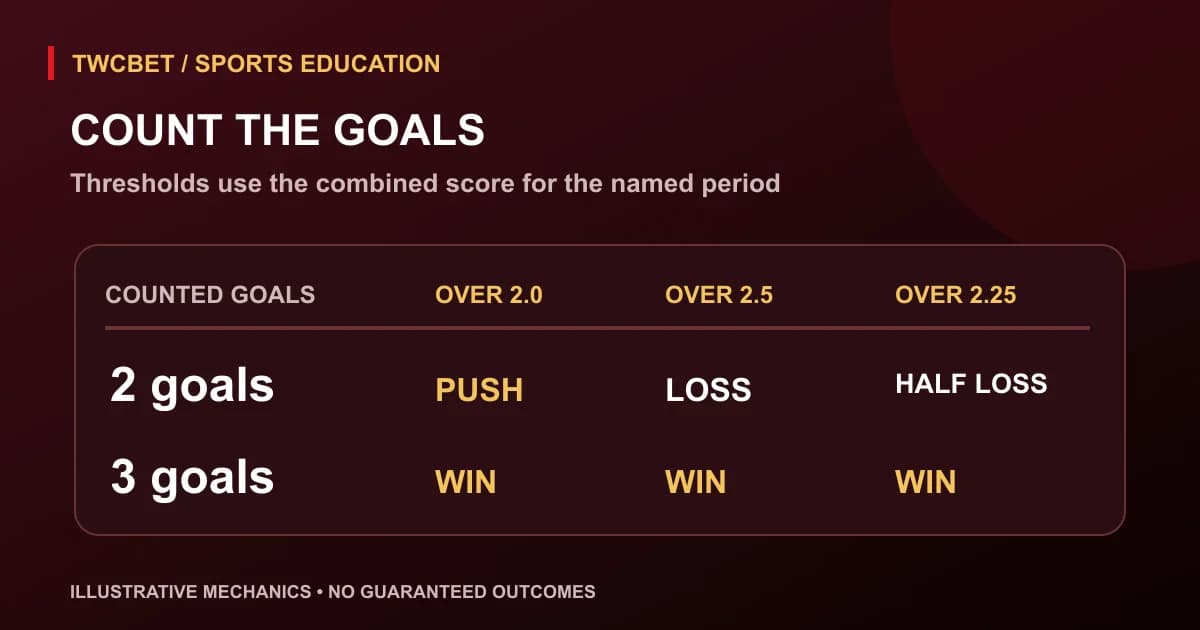
Over 2.25 typically divides the stake equally between over 2.0 and over 2.5. With two goals, the whole-line component pushes and the half-line component loses. With three goals, both win. With fewer than two, both lose. The quarter number is shorthand for two settlements, not a possible fraction of an actual goal.
Over 2.75 divides the stake between over 2.5 and over 3.0. Exactly three goals gives a win on the first half and a push on the second. Under 2.75 divides it between under 2.5 and under 3.0, so exactly three produces a loss on one half and a push on the other.
Write the components before considering money. With a RM20 stake, each component uses RM10. Resolve each one against the counted total, calculate its returned amount and then add both amounts. This approach also helps distinguish a half loss from a reduced winning profit, which are financially different outcomes despite both involving only part of the original stake.
06
Worked examples at the boundary
Consider RM20 at 1.90 on over 2.25. A 1–1 score gives two goals. The RM10 over-2.0 component returns RM10 as a push, while the RM10 over-2.5 component returns nothing. Combined total return is RM10 and the net result is minus RM10. The selection has suffered a half loss.
Now take RM20 at 1.90 on over 2.75 with a 2–1 score. Three goals make the RM10 over-2.5 part win, returning RM19. The RM10 over-3.0 part pushes, returning RM10. Total return is RM29 and net profit is RM9. Neither example uses half of the full RM38 winning return as a shortcut.
At four goals, both components of either illustrated over selection win, returning RM38. At one goal, both lose. These cases show why the boundary score deserves special attention. A line's most confusing result is often the neighbouring whole number, where a push interacts with a winning or losing half.
07
Confirm the period and live basis
First-half totals, second-half totals and full-match totals use different counting windows. If the first half ends 1–0 and the match finishes 2–1, the first-half total is one and the match total is three. A full-time result cannot be substituted into an earlier-period contract, even though both concern the same fixture.
Stoppage time and extra time are different concepts. Read the service's stated coverage instead of assuming a total includes every minute of a knockout tie. Likewise, penalty-shootout scores should not be added to the match goal count unless a market explicitly defines such a condition. A sporting winner and a settled goal total answer different questions.
For an in-play total, identify whether the line covers the complete match or only action after acceptance. If the score is already 1–1, a complete-match over 2.5 contract is different from a remainder-total over 2.5 contract. Do not reset the score mentally without seeing that basis in the actual market rules.
08
Avoid statistical shortcuts and pressure
An average goals figure is a description of a dataset, not a promise about the next match. Two teams with the same average can have different score distributions, and a short sample can be misleading. This guide concerns contract mechanics rather than a method for predicting totals or finding supposedly certain results.
Do not add an unplanned selection because a late goal feels likely or because a half loss seems recoverable. The remaining uncertainty still matters, and every additional stake adds exposure. Keep the budget, time and number of selections fixed under the sports-session planning guide.
Read the accepted label slowly, calculate with the correct period and preserve the receipt. If you cannot explain the settlement at exactly two or three goals for a quarter line, practice on paper first. There is no requirement to participate after learning, and avoiding an unclear contract is often the most useful outcome of the exercise.
09
References and related reading
For the distinction between playing time and additional knockout procedures, consult IFAB Law 7 and Law 10. They explain football rules, not TWCBet settlement terms. The service's current market contract determines which of those periods a total includes.
The threshold tables and RM examples above are original educational calculations. Check the exact market wording, competition and funding conditions before transferring them to a real receipt. The responsible-gambling page supplies broader guidance if results, live scores or the desire to recover spending start affecting your decisions.
Editorial standards
TWCBET guides explain categories and safer-play principles in plain language. Always confirm the rules, limits, eligibility, and terms shown by the service before taking part.