
Key takeaways
- 1X2 chooses one of home win, draw or away win for a specified period.
- Double chance covers two named outcomes, but does not guarantee a win.
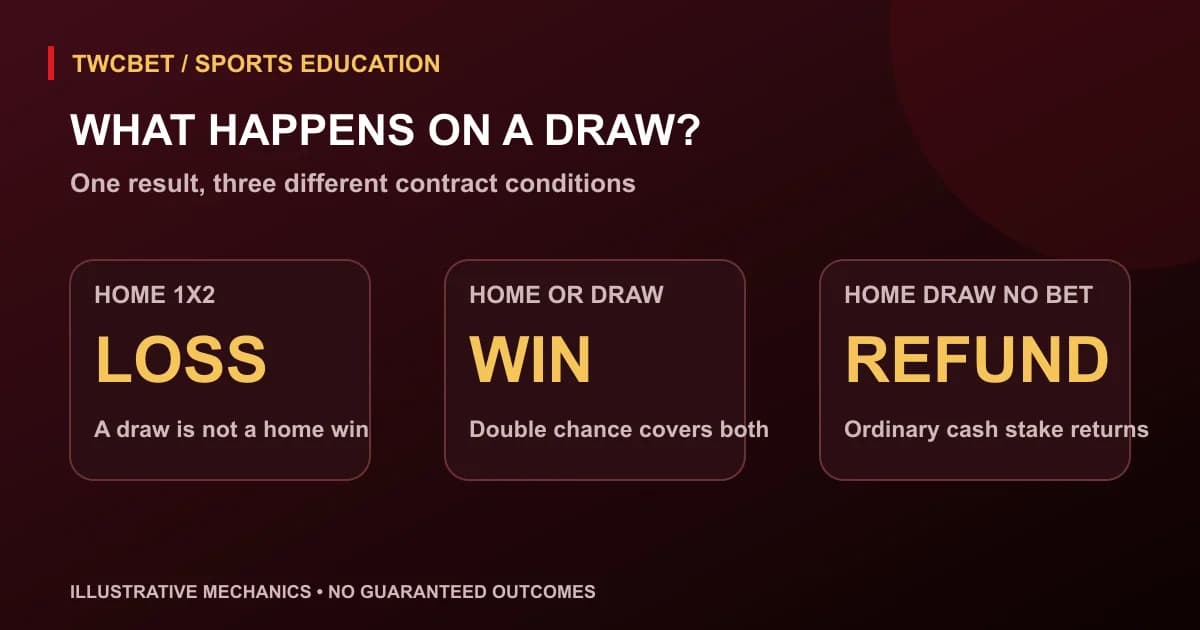
- Draw no bet returns an ordinary cash stake on a draw under conventional rules.
- Compare coverage and period alongside odds; qualification is a different condition.
01
Three contracts for the same football result
1X2, double chance and draw no bet all use football results, but handle the draw differently. 1X2 selects one outcome. Double chance selects a pair of outcomes. Draw no bet selects a team to win while conventionally refunding an ordinary cash stake if the included period finishes level. Their names are shorthand for different settlement contracts.
In standard 1X2 notation, 1 means the listed home team, X means the draw and 2 means the listed away team. Those labels depend on the event's ordering, including matches at neutral venues. They do not necessarily tell you which team is physically playing in its normal stadium. Confirm the fixture before reading the price.
The TWCBetPro homepage links to the site's category resources, while the event-page guide covers the broader interface. This article focuses on comparing result conditions rather than navigating a sportsbook. Examples use hypothetical teams and conventional cash settlement, without implying that a particular market is currently offered by TWCBet.
02
How 1X2 settles
A home-win selection wins only if the listed home team wins the included period. A draw selection wins only if that period is level. An away-win selection wins only if the listed away team wins. Choosing a strong team does not remove the draw from the contract, and a drawn result loses a conventional home-win or away-win selection.
Suppose the home team and away team finish regulation time at 1–1. The X selection wins, while 1 and 2 lose. If the same knockout fixture later produces a home winner in extra time, that later sporting outcome does not automatically change a regulation-time 1X2 settlement. The accepted period remains the reference.
At hypothetical odds of 2.40, a RM10 home-win stake returns RM24 if the home team wins that period. It returns zero if the period is drawn or the away team wins. RM14 is the winning net profit, not RM24. Use the decimal-odds guide to keep return and profit separate.
03
How double chance settles
Double chance combines two of the three result outcomes. 1X covers home win or draw. X2 covers draw or away win. 12 covers either team winning, with a draw losing. The numbers refer to covered outcomes rather than the number of goals or the final score. Read the complete pair before confirming.
For a 1–1 result, 1X and X2 win while 12 loses. For a 2–0 home win, 1X and 12 win while X2 loses. For a 0–1 away win, X2 and 12 win while 1X loses. No pair covers every possible result, which is why the name should never be interpreted as risk-free participation.
Covering an additional outcome commonly changes the offered price, but there is no universal conversion from one 1X2 price to a double-chance price. Compare actual contracts for the same period rather than assuming the payment terms must match a formula from another service. A wider condition is still uncertain and can still lose the entire cash stake.
04
Draw no bet and the refunded draw
Draw no bet conventionally has three possible financial outcomes for an ordinary cash stake: a win if your team wins, a refund if the period is drawn and a loss if your team loses. The refunded draw produces zero net profit. It is different from double chance, where a covered draw is a winning outcome paid at the accepted odds.
For RM10 on the home team at 1.80, a home win returns RM18, a draw returns RM10 and an away win returns zero. By contrast, a hypothetical RM10 home-or-draw selection at 1.50 returns RM15 on either a home win or a draw, and zero on an away win. These prices are illustrations, not market quotes.
The distinction also affects records. A refund brings your original money back; it does not add RM10 of profit. For conventional settlement, a zero Asian handicap has the same result pattern as draw no bet. Read the Asian-handicap explainer for the separate language used in handicap markets.
05
Compare the outcome table
Use a result table before comparing any prices. The table below assumes that all markets use the same completed period and conventional cash rules. Mixing a first-half 1X2 market with a full-match double-chance market would invalidate the comparison because the rows would no longer refer to the same sporting result.
A useful paper exercise is to add a stake and price to each row, then calculate the returned cash in all three columns. This reveals differences that labels alone can hide. Use hypothetical figures and leave the stake uncommitted; understanding a comparison does not require testing it with money.
| Selection | Home win | Draw | Away win |
|---|---|---|---|
| 1X2: home / 1 | Win | Loss | Loss |
| 1X2: draw / X | Loss | Win | Loss |
| 1X2: away / 2 | Loss | Loss | Win |
| Double chance 1X | Win | Win | Loss |
| Double chance X2 | Loss | Win | Win |
| Double chance 12 | Win | Loss | Win |
| Home draw no bet | Win | Refund | Loss |
| Away draw no bet | Loss | Refund | Win |
06
Match result is different from qualification
A match-result contract evaluates a defined playing period. A to-qualify contract evaluates which team progresses under its rules. These can settle differently when a tie involves extra time, penalties or more than one leg. Do not use the eventual tournament bracket as proof that a regulation-time result selection should have won.
For example, imagine a knockout game ends 0–0 after regulation and the away team progresses after later tie-breaking procedures. A regulation-time draw is still a draw. An away qualification selection concerns progress, while an away regulation-win selection concerns winning that earlier period. There is no contradiction if the two contracts settle differently.
IFAB Law 10 explains permitted procedures for deciding a winner when competition rules require one. Those sporting procedures do not by themselves determine a betting contract's included period. The source clarifies the distinction; the actual operator's accepted rules still determine the settlement.
07
Check price, funding and interrupted fixtures
A price comparison should keep event, period, covered outcome and funding type constant. Promotional credit may not return its face-value stake on a win or a refund in the same way as ordinary cash. If a receipt looks different from the table, inspect those conditions before assuming the financial treatment is wrong.
Postponement or abandonment rules are another separate layer. A market can be void even though its normal result table is clear, or an already-determined market may have specific treatment. Do not interpret an unplayed fixture as a sporting draw. A refunded void and a draw-no-bet refund can both return money for entirely different reasons.
Save the accepted market label and reference number. A selection labelled simply home on a compact card may omit the period or the contract type visible in the full slip. If the wording remains unclear, stop and obtain clarification through a verified support route instead of inferring the contract from its price alone.
08
Choose clarity over reassuring labels
Double chance and draw no bet can sound protective because they widen a condition or refund a draw. That wording should not justify a larger stake. Double chance still has an uncovered losing result, and draw no bet still loses when the selected team loses. The maximum ordinary cash loss on each single selection remains its full stake.
There is no universally best market. The educational question is whether you can identify its winning, refunded and losing conditions accurately, including the period. A person who prefers not to risk money can learn the same distinctions by filling in the table with imaginary results. Participation is not a necessary next step.
Keep session limits fixed using the sports-session planning guide. If reassuring labels encourage you to ignore losses or keep adding selections, use the responsible-gambling resources and take a break. Market coverage cannot make gambling an investment or a reliable income stream.
09
A final comparison checklist
Before interpreting a result selection, record the listed home and away teams, exact market name, covered outcome or pair, included period, accepted odds, stake type and interruption rules. Then describe what happens if the period ends drawn. That single question often exposes the difference between 1X2, double chance and draw no bet.
For further context, return to the guide library and connect this comparison with odds arithmetic and handicap settlement. The examples here deliberately avoid forecasts, current team form or claimed profitable strategies. They explain what a contract means so you can read it accurately, recognize uncertainty and decide whether to leave it alone.
Editorial standards
TWCBET guides explain categories and safer-play principles in plain language. Always confirm the rules, limits, eligibility, and terms shown by the service before taking part.