
Key takeaways
- Decimal odds include the returned stake; total return and profit are different amounts.
- Implied probability is 100 divided by decimal odds, not a verified forecast.
- A complete market can imply more than 100 percent because of its pricing margin.
- Understanding arithmetic does not remove gambling risk or justify a larger budget.
01
What decimal odds tell you
Decimal odds show the total return per unit staked when a standard fixed-odds selection wins. At 2.50, every RM1 staked produces RM2.50 in total return, including that RM1. If the selection loses, the stake is lost. A price tells you the payment terms attached to an outcome; it does not promise that outcome will happen.
For Malaysian readers, using ringgit in examples makes the arithmetic easier to check, but currency does not change the formula. The examples here are hypothetical, assume ordinary cash stakes, and exclude promotional conditions, fees, partial settlements and tax treatment. They are educational illustrations rather than available TWCBet offers or betting recommendations.
Start from the TWCBetPro homepage if you need the category navigation, then use the sports event-page guide to locate the complete market label. The price is meaningful only alongside the selected participant, market condition and included period. Reading 2.50 without knowing what must happen leaves the most important part unanswered.
02
Calculate total return and net profit separately
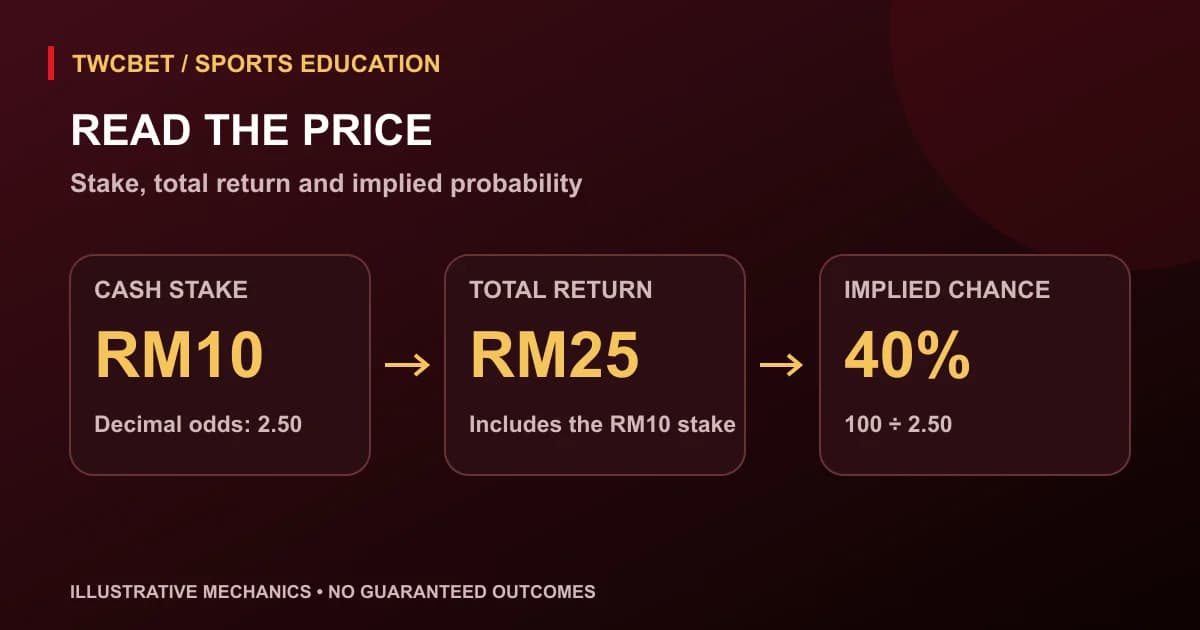
The basic formula is stake multiplied by decimal odds. For a RM10 stake at 2.50, total return is RM25. Net profit on that winning selection is RM25 minus RM10, or RM15. A displayed return of RM25 therefore does not mean RM25 of new money has been earned. RM10 of it is the original stake coming back.
For a losing cash selection, the total return is normally zero and the net result is minus RM10. For a conventional refunded selection, RM10 returns and the net result is zero. These three outcomes help you read a receipt without mixing stake, payment and profit. Always use the actual settlement record when a different rule applies.
Check rounding against the receipt, particularly when odds have several decimal places. An illustrative calculator might round only at the end, while the service may apply its stated precision rules to individual settlements. A few sen of difference should be investigated through those rules rather than treated as evidence of a different stake.
| Cash stake | Decimal odds | Winning total return | Winning net profit |
|---|---|---|---|
| RM10 | 1.50 | RM15.00 | RM5.00 |
| RM10 | 1.80 | RM18.00 | RM8.00 |
| RM10 | 2.00 | RM20.00 | RM10.00 |
| RM10 | 2.50 | RM25.00 | RM15.00 |
| RM10 | 4.00 | RM40.00 | RM30.00 |
03
Convert odds into implied probability
For a simple win-or-lose selection, implied probability equals 1 divided by decimal odds. Multiply by 100 to express it as a percentage. Odds of 2.50 therefore imply 40 percent; odds of 2.00 imply 50 percent; odds of 1.25 imply 80 percent. Shorter decimal prices correspond to higher implied percentages.
Another way to understand the calculation is through a deliberately simplified break-even model. Suppose a RM10 selection at 2.50 has only full wins and full losses, and its true chance were exactly 40 percent. Over many hypothetical repetitions, the expected total return per attempt would be 0.40 multiplied by RM25, or RM10. This is a mathematical relationship, not a claim that any real selection has that true chance.
The simple reciprocal is less complete for markets with pushes, split stakes or other partial settlements. A price on a handicap that can return the stake cannot automatically be interpreted as a full, unconditional winning probability. Identify all possible settlement outcomes before using a familiar formula outside the simple model.
04
Why implied probability is not a prediction
Implied probability is extracted from a price. It is not a measured probability, a guarantee or an independent assessment by a sports governing body. Prices can incorporate a provider's margin, customer demand, available information and operational decisions. A team offered at 1.25 can still lose; the price never makes that possibility disappear.
Likewise, a movement from 2.50 to 2.20 raises the implied percentage from 40 percent to approximately 45.45 percent. That calculation describes the new price. It does not prove the team's true chance increased by exactly 5.45 percentage points, nor does it establish why the price moved. A screenshot of the earlier odds supplies even less evidence about the cause.
Avoid labelling a selection certain because its odds look small. If an outcome were truly guaranteed, the usual uncertainty model would not apply. In everyday sports markets, injuries, errors, competition and ordinary variation remain possible. Understanding the number helps describe a contract; it cannot turn a forecast into a fact.
05
Read the margin across a complete market
Consider an illustrative three-outcome market priced at 2.00 for the home team, 3.50 for the draw and 4.00 for the away team. Their reciprocal percentages are 50, approximately 28.57 and 25. Added together, they give approximately 103.57 percent. The amount above 100 percent is commonly called the overround.
This calculation requires a complete set of mutually exclusive outcomes covering the same event and period. Do not add a home-win price from regulation time to a draw price from the first half or an away qualification price. Those outcomes belong to different contracts and cannot describe one complete probability distribution.
Dividing each percentage by their total would make the numbers sum to 100 percent. That normalization is a calculation convention, not proof you have recovered the true sporting probabilities or removed every commercial effect from the prices. The margin also does not equal the exact loss any individual will experience in a short session.
06
Check the odds format before calculating
Different interfaces may display odds in different formats. A number that looks like a decimal price is not enough to identify the format with confidence. Check the active setting or help label. Under a decimal format, 1.80 includes the returned stake; calculations for a profit-only display or a signed odds format work differently.
You do not need to memorize every conversion system to avoid this mistake. First identify the displayed format, then compare the receipt's stake and potential return with a small calculation. If RM10 at a displayed decimal 1.80 does not correspond to RM18 for a conventional full win, pause and inspect the contract, credit type or display setting.
Use the accepted price rather than a cached event card. Changing prices before confirmation can change the payment terms. A potential return attached to an unsubmitted selection is only a preview. Until acceptance is confirmed, neither the displayed price nor that preview demonstrates an active betting contract.
07
Apply the numbers without increasing risk
A useful practice exercise is to calculate three hypothetical returns on paper without placing anything. For each one, write the stake, price, total winning return, net winning profit and full-loss amount. This makes the downside as visible as the attractive return, and lets you spot whether a calculator is showing total payment or profit.
Do not use a calculation to expand an entertainment budget. A larger potential payment comes with an uncertain outcome, and higher stakes increase the amount that can be lost. The responsible sports-session plan covers fixed money and time limits. Arithmetic should fit inside those limits, never become a reason to revise them mid-session.
If you feel an urge to recover an earlier loss through a larger stake, stop the calculation and close the session. The responsible-gambling page explains warning signs and available next steps. Knowing odds thoroughly does not protect someone from chasing, fatigue or decisions made under pressure.
08
A practical reading sequence and related resources
Read an odds entry in this order: exact event, selected outcome, included period, odds format, accepted price, cash stake and settlement rules. Only then calculate the potential total return. This order prevents a perfectly accurate multiplication from being attached to the wrong participant or market.
For independent descriptions of display formats, see Pinnacle's odds-format help. It describes another operator's interface, not a TWCBet feature list. The numerical examples in this article are our own illustrations. Always confirm the format and payment rules in the service you actually use.
Return to the guide library when a market term is unfamiliar. The most useful next step is to connect the price calculation with the exact result condition. You can understand the full educational example without risking money, and choosing not to participate remains a valid outcome of learning how the mechanics work.
Editorial standards
TWCBET guides explain categories and safer-play principles in plain language. Always confirm the rules, limits, eligibility, and terms shown by the service before taking part.