
Key takeaways
- An ordinary accumulator requires every remaining leg to satisfy its winning condition.
- Combined decimal odds multiply; the displayed return still includes the cash stake.
- A conventional void leg often becomes 1.00, but promotions and special products can differ.
- More legs add uncertainty, and correlated selections cannot use simple independence assumptions.
01
What an accumulator combines
An accumulator, also called an acca or parlay, joins multiple selections into one contract. In an ordinary all-to-win version, every non-void leg must win for the accumulator to win. A double has two legs and a treble has three. One losing leg normally loses the full accumulator stake even if the other legs win.
A single cash stake funds the combined contract. It is not divided into separate standalone stakes that can each pay independently. This is why three winning selections and one losing selection do not normally produce three independent winning payments from an ordinary four-leg accumulator. Other products, such as system bets, have different structures.
The TWCBetPro homepage provides the route to educational resources. Read the decimal-odds guide first if multiplication and stake-inclusive returns are unfamiliar. The examples here are hypothetical conventional accumulators, not a claim about current product availability, promotional offers or TWCBet-specific settlement policy.
02
Calculate combined odds and return
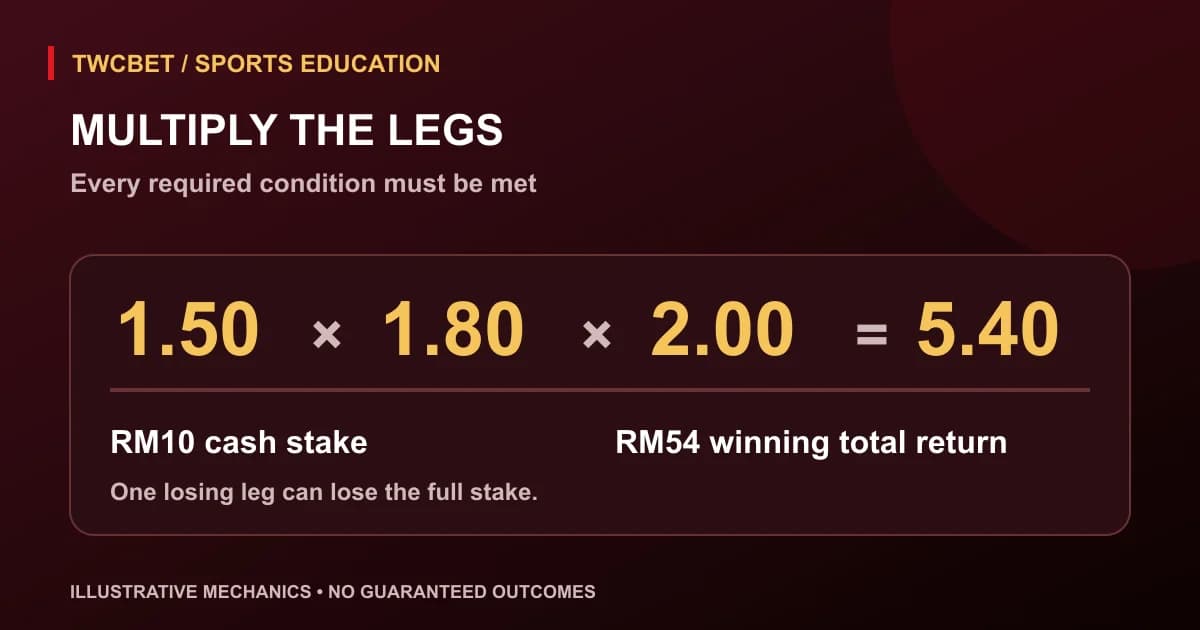
For an ordinary accumulator with accepted decimal prices of 1.50, 1.80 and 2.00, multiply 1.50 by 1.80 by 2.00 to get combined odds of 5.40. A RM10 cash stake gives a potential winning total return of RM54. Subtract the RM10 stake to obtain RM44 net profit if every required leg wins.
The combined total is not found by adding 1.50, 1.80 and 2.00. Nor is RM54 the amount earned in addition to the original stake. Keeping those two distinctions clear avoids an inflated impression of the payment. If one leg loses under ordinary rules, total return is zero and net result is minus RM10.
This arithmetic assumes unmodified decimal prices and no boost, cap, deduction or special rule. The accepted receipt controls the actual contract. A displayed quote that differs from the multiplication may reflect a special product or revised price; investigate the wording rather than forcing the receipt to match a simplified example.
| Leg | Accepted decimal odds | Running combined odds | RM10 potential total return |
|---|---|---|---|
| First | 1.50 | 1.50 | RM15.00 |
| Second | 1.80 | 2.70 | RM27.00 |
| Third | 2.00 | 5.40 | RM54.00 |
03
Why adding legs adds uncertainty
Each required condition is another opportunity for the combined selection to fail. A small price on one leg does not make it certain. The temptation to add one apparently easy outcome for a larger payment can hide the fact that the entire accumulator now depends on that outcome as well as all existing legs.
In a purely hypothetical independence model, suppose three events each have a true 60 percent chance. The chance that all three happen is 0.60 multiplied by 0.60 multiplied by 0.60, or 21.6 percent. That example is mathematical, uses invented probabilities and makes no claim about the true chances of any actual sporting event.
Implied probabilities extracted from odds are not verified true probabilities. Multiplying them does not automatically create a reliable forecast for an accumulator. A provider's pricing margin and the relationships between selections also matter. Larger quoted returns should be read alongside the full-loss scenario, rather than as evidence that the structure creates value or dependable income.
04
Recognize dependence between selections
Two selections can depend on the same match conditions. A team's match win and that team's goal total, for example, are not automatically independent. Knowing one outcome can change the probability of the other. The multiplication rule for independent event probabilities cannot be used without checking that assumption.
Same-game combinations may therefore use dedicated pricing, reject particular pairs or apply specific settlement rules. Do not assume that multiplying standalone prices reproduces a permitted same-game quote. Even different fixtures can share relevant conditions, so independence is a modelling assumption rather than a feature guaranteed by the number of matches.
A useful educational exercise is to write why two hypothetical selections might move together. You do not need to estimate an exact correlation coefficient to recognize that the simple independence example is inappropriate. If you cannot describe the combined condition or its accepted price, leave the combination unconfirmed and return to the basic market explanations.
05
What a conventional void leg can do
In many ordinary accumulator contracts, a void leg is removed from the payment calculation by treating its odds as 1.00. Suppose the 1.80 leg in our treble becomes void, while the other two win. Combined odds become 1.50 times 1.00 times 2.00, or 3.00. RM10 then returns RM30, with RM20 net profit.
The original RM54 preview no longer applies. A refund on one component does not necessarily refund the entire accumulator. Likewise, a void leg does not rescue an independent losing leg: if one remaining leg loses, the ordinary accumulator still loses. Record the adjusted contract instead of relying on the first potential-return display.
Actual treatment varies for promotions, insurance, same-game products and minimum-leg offers. A void might change eligibility for a boost or another condition even when the underlying accumulator continues. Read the current rules for the precise product; a general illustration cannot establish how every service handles those extra layers.
06
Pushes and partial settlements need more care
A whole-line handicap can push, and a quarter line can generate mixed half-stake results. Putting these markets into a multiple creates more complicated payment paths than an all-win or one-void example. Do not treat a half win as a full winning leg at the original odds or invent an adjusted price from memory.
Check the rules and the expanded settlement record. Where a provider permits quarter-line legs, the contract may effectively need component calculations to determine the final return. The Asian-handicap guide explains a single selection's split before you attempt to interpret a combination containing it.
For result markets, the 1X2 and draw-no-bet comparison helps identify which outcomes win and which refund. A drawn result has different financial treatment depending on the accepted contract. The leg's title should therefore remain attached to its odds and included period in your records.
07
Acceptance and confirmation checks
Before submitting a combined selection, read each leg separately and then the combined contract. Confirm the event, market, participant, line, included period, accepted odds and cash stake. Similar team names, neighbouring handicap lines and different playing periods are easy to overlook when the slip has many rows.
Do not confuse a saved draft with an accepted accumulator. A quote can change or become unavailable before submission completes. After any timeout, inspect the account history for an accepted reference before trying again. A second submission can create extra exposure if the first request was already accepted but its confirmation failed to display.
Keep a receipt until every leg settles. One settled leg does not mean the combined stake is ready to treat as a payment, and a pending leg can still lose. Do not spend against the potential return or count it as funding for later selections. It is an uncertain preview until the contract has settled.
08
Budget for the full stake, not the appealing preview
A RM10 accumulator can lose RM10 in full. Multiple small accumulators can also add up to a large total spend, even if each preview looks modest. Record the aggregate stakes committed during the session instead of focusing only on the largest potential payment shown in a slip.
The sports-session planning guide recommends fixed money, time and selection limits. Those limits apply to combined contracts as well as singles. A promotion, near miss or winning streak should not increase the amount you had decided you could afford to lose.
Be especially cautious about calling a narrowly losing accumulator almost a win. Its accepted contract still lost, and repeating it with a larger stake does not recover the earlier result reliably. If that thinking starts driving decisions, stop and use the responsible-gambling guidance. Learning the mechanics is compatible with choosing not to participate.
09
Sources and next steps
For an independent example of how a provider distinguishes multiple-bet rules and special conditions, consult Betfair's published general sportsbook rules, particularly its multiples section. These are Betfair's terms, not TWCBet terms. The original arithmetic above illustrates a conventional product and does not establish another service's obligations.
The next useful exercise is to recalculate our treble after voiding a different leg, then compare the outcome with one losing leg. Work on paper, keep total return and net result separate, and avoid attaching the figures to a predicted sporting event. The aim is accurate reading of a combined contract, not a strategy for creating guaranteed profit.
Editorial standards
TWCBET guides explain categories and safer-play principles in plain language. Always confirm the rules, limits, eligibility, and terms shown by the service before taking part.