
Key takeaways
- A handicap adjusts the settlement comparison, not the actual match score.
- Whole lines can push; half lines cannot tie under ordinary whole-goal scoring.
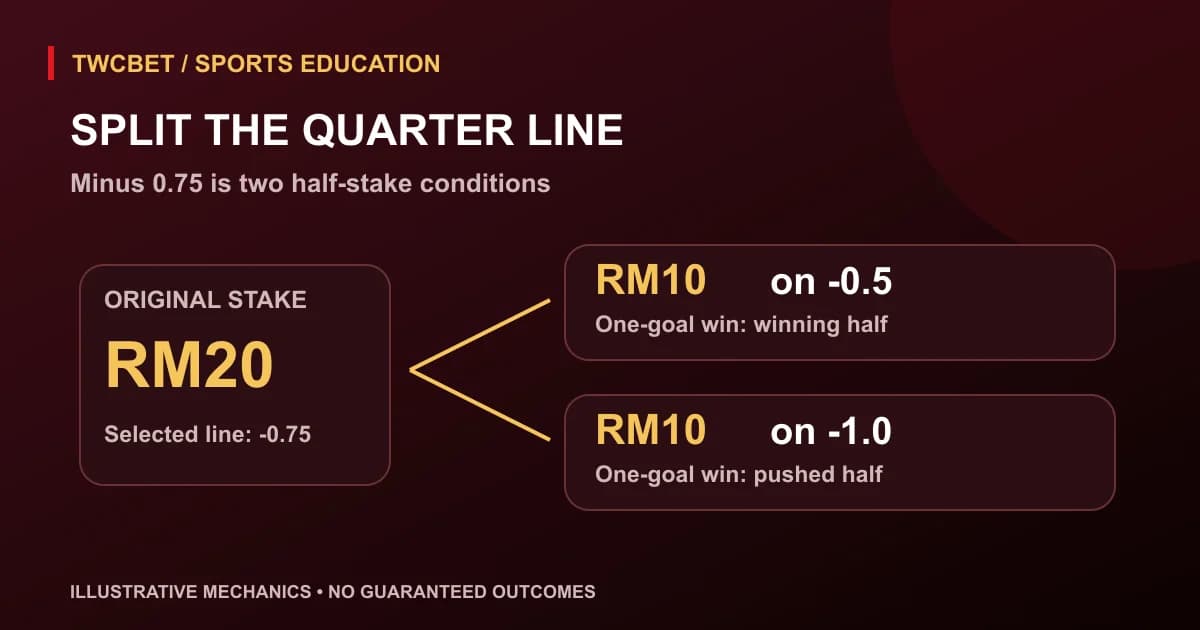
- Quarter lines divide the stake equally across two adjacent lines.
- Read the selected team, sign, period and full rules before interpreting a result.
01
Understand the adjustment before the odds
An Asian handicap adds or subtracts a stated number from a team's score for the purpose of settling a market. It does not change the match result recorded by the competition. The selected team's adjusted result is compared with its opponent's result for the period covered by the market. Both the number and its sign matter.
A minus line asks the selected team to overcome a deduction. A plus line gives it an allowance in the settlement calculation. For example, minus 1.5 requires a winning margin greater than 1.5 goals; plus 1.5 can still win when the selected team loses by one goal. Neither line predicts what the teams will do.
Use the TWCBetPro homepage to find the educational categories, and the event-page guide to check where team names, lines and periods appear. This article explains common mechanics through hypothetical football examples. It does not claim that every illustrated market is available on TWCBet or that every provider settles it identically.
02
Read the team and the sign together
A compact way to calculate the result is selected-team goals minus opponent goals plus the selected handicap. If that adjusted margin is positive, the selection wins; if negative, it loses. For a conventional whole-goal Asian line, exactly zero is a push and the cash stake is returned. Start with the actual score from the specified period.
Suppose the home team wins 2–1. Its actual margin is plus one. Home minus 0.5 produces an adjusted margin of plus 0.5 and wins. Home minus 1 produces zero and pushes. Home minus 1.5 produces minus 0.5 and loses. The same sporting result has three different settlements because the contracts are different.
Do not reverse the sign when reading an away selection. Away plus 1.5 is applied to the away team's score, not automatically deducted from the home team in every display convention. Writing the selected participant explicitly before doing arithmetic is a simple way to avoid mixing sides on a crowded mobile screen.
03
Whole and half lines compared
Whole lines include zero, plus one, minus one and other integer adjustments. They allow an exact equality after adjustment. Half lines sit between possible whole-goal margins, so the comparison cannot finish exactly level in an ordinary completed football match. That difference explains why a push is possible on one contract but not the other.
A zero Asian handicap commonly has the same win/draw/loss settlement pattern as draw no bet: a selected-team win wins, a draw returns the stake and a loss loses. Confirm the actual market label because a three-way European handicap includes a handicap-draw selection and is a different product. An integer number alone does not identify the market type.
The table assumes a completed match, conventional two-way Asian-handicap settlement and the same included period throughout. Interrupted events and special formats can require separate rules. It is a comparison of conditions, not a ranking of better selections or an instruction to choose the line with the widest allowance.
| Selected line | Team wins by one | Match drawn | Team loses by one |
|---|---|---|---|
| -1.5 | Loss | Loss | Loss |
| -1.0 | Push | Loss | Loss |
| -0.5 | Win | Loss | Loss |
| 0 | Win | Push | Loss |
| +0.5 | Win | Win | Loss |
| +1.0 | Win | Win | Push |
| +1.5 | Win | Win | Win |
04
Quarter lines are two half-stake contracts
A quarter line sits halfway between adjacent whole and half lines. Minus 0.25 divides the stake across 0 and minus 0.5. Minus 0.75 divides it across minus 0.5 and minus 1. Plus 1.25 divides it across plus 1 and plus 1.5. The division is normally equal, rather than the entire stake being placed on each component.
For a RM20 stake on minus 0.75, write two separate RM10 entries on paper. Apply minus 0.5 to the first and minus 1 to the second. If the team wins by one, the first part wins and the second pushes. If it wins by two, both win. If it draws or loses, both lose.
The labels half win and half loss describe a mixture of settlements. They do not mean that the whole selection pays half of the displayed total return. To find the actual payment, settle each component with its own half-stake, then add the returned amounts. This method works more reliably than trying to memorize a compressed phrase.
05
Work through a half-win payment
Take RM20 at decimal odds of 1.90 on a team minus 0.75. The team wins 2–1 within the included period. RM10 on minus 0.5 wins and returns RM19, including that component's stake. RM10 on minus 1 pushes and returns RM10. Combined total return is RM29, with RM9 net profit against the original RM20.
For a two-goal win, both RM10 components return RM19, giving RM38 total and RM18 net profit. For a draw, both return zero, so the RM20 stake is lost. Comparing these three outcomes makes clear why a half win is not the same as a full win at half of the original odds.
Use the decimal-odds guide if the difference between total return and profit is unfamiliar. Quarter-line calculations combine that arithmetic with a two-part settlement. Promotional stakes, deductions and nonstandard precision rules can change the payment calculation, so the example assumes ordinary cash stakes and no additional conditions.
06
Work through a half-loss payment
Now consider RM20 at 1.90 on plus 0.25 when the match ends drawn. Half the stake is on zero, which pushes, and half is on plus 0.5, which wins. Total return is RM10 plus RM19, or RM29. The plus sign changes the outcome compared with minus 0.25 for the same drawn score.
With minus 0.25 on that draw, RM10 on zero returns RM10 while RM10 on minus 0.5 loses. Total return is RM10, and the net result is minus RM10. This is a half loss. The returned amount is a stake refund, not winning profit that can reasonably be treated as evidence of success.
Avoid using a losing result as a prompt to double the next stake. A partial loss still consumes part of the entertainment budget, and a later selection can lose in full. Your limits should be based on money you can afford to lose, rather than on whether a settlement label sounds less severe than another.
07
Periods, live scores and common reading errors
A first-half handicap uses the first-half result; a full-match contract uses whatever period its rules define. Do not apply the final score to a first-half selection. Likewise, live handicap interfaces can distinguish a final-score contract from a remainder-of-match contract. Read whether the current score is included, rather than assuming every live line starts from zero.
Another error is comparing prices without comparing lines. Minus 0.5 at 1.85 and minus 1 at 2.10 are different settlement conditions. The larger price does not automatically make the second entry preferable. It asks for a different result, and a one-goal win can settle them differently. Keep participant, period, handicap and odds together as one record.
Before confirmation, say the condition in plain language: this selected team needs this margin within this period, with these push or split rules. If you cannot explain it, leave the market alone. The sports overview provides a route back to the basic categories without requiring any participation.
08
Sources, limits and next steps
Betfair's Asian-handicap explainer provides an independent example of whole, half and split-line mechanics. It concerns Betfair's product, including exchange-specific details that are not assumed here. The examples and payment calculations above are original, and the actual service's accepted market and current rules remain the authority for settlement.
A useful next step is to practice plus 0.25 and minus 0.75 against three imaginary scores, settling each half-stake separately. Do this without placing a selection. If the resulting payments differ from what you expected, revisit the sign and the component lines before looking at more complicated markets.
Keep money and time limits fixed while learning. The responsible-gambling guidance remains relevant even when a contract seems mathematically clear. Understanding pushes and partial returns reduces confusion; it does not create guaranteed winnings, eliminate uncertainty or make gambling a reliable source of income.
Editorial standards
TWCBET guides explain categories and safer-play principles in plain language. Always confirm the rules, limits, eligibility, and terms shown by the service before taking part.