
Key takeaways
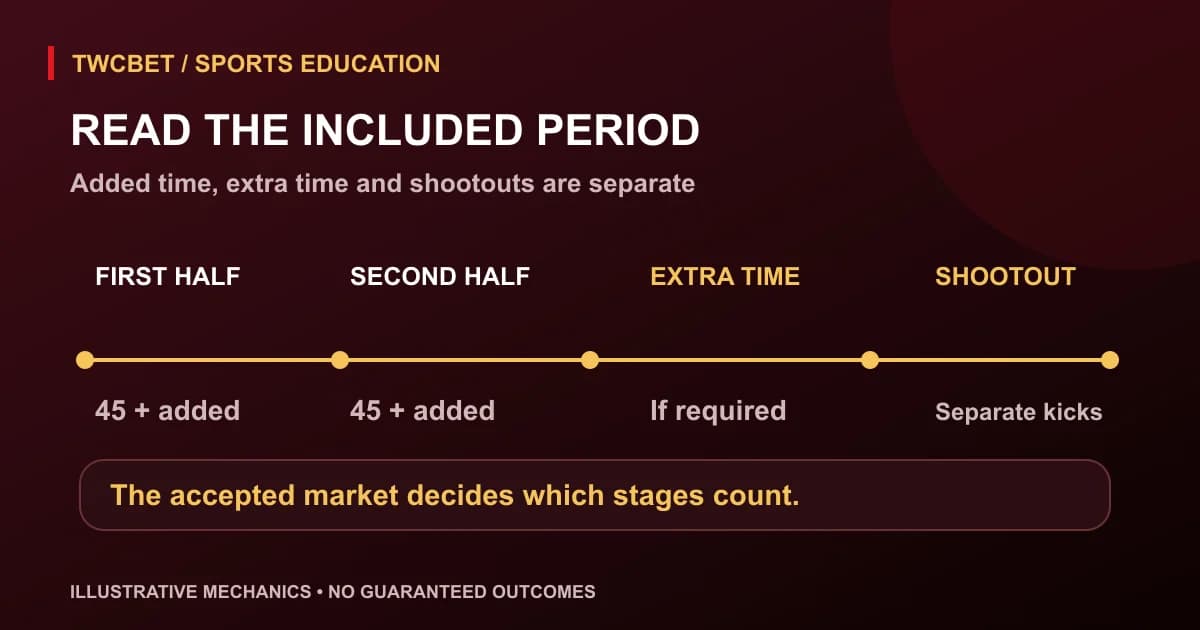
- Stoppage time belongs to its half; extra time is a separate knockout stage.
- A market's included period controls settlement, not the eventual competition winner.
- Shootout kicks are distinct from goals scored during play.
- Match result, qualification and first-half markets can settle differently on one fixture.
01
Start with the market's clock
Football markets evaluate a defined period, not automatically every action until a trophy or qualifying place is decided. A regulation-time result, first-half total, extra-time result and to-qualify selection can all concern one fixture while using different conditions. Read the full period label before interpreting any score or price.
Stoppage time, also called added time, is time allowed at the end of a half. Extra time is a separate procedure that competition rules may use when a winner is required after a draw. A penalty shootout is another distinct procedure. Treating these phrases as interchangeable creates settlement mistakes even when the final winner is obvious.
Use the TWCBetPro homepage to reach the educational categories. For result conditions, read the 1X2, double-chance and draw-no-bet comparison. This guide focuses on when goals and results are counted, with hypothetical examples and no claim that TWCBet currently offers each illustrated market.
02
What added time means
Under IFAB Law 7, standard adult football has two 45-minute halves, subject to the permitted competition arrangements. The referee allows time for specified interruptions and delays. The board indicates a minimum allowance, rather than an exact promise that the whistle will sound when that number is reached.
Added time belongs to the half in which it is played. A goal recorded at 45+3 is in first-half added time; a goal at 90+4 is in second-half added time. These labels should not be mistaken for the separate extra-time periods used in some knockout formats. The displayed minute helps identify the sporting period but does not replace the market rules.
For an ordinary market explicitly covering regulation plus added time, a valid goal at 90+4 is inside the included period. Still check the wording for the precise contract, especially in nonstandard competitions. The central reading habit is to connect the goal with its period rather than deciding that any minute above 90 must be extra time.
03
Extra time is a separate stage
When competition rules require a winner, permitted tie-breaking procedures may follow a drawn match. IFAB Law 10 describes the framework for deciding that outcome. A competition's actual format determines whether extra time is used and how the tie proceeds; do not assume every drawn knockout match follows the same sequence.
An extra-time market might cover only that stage, while a different market might combine regulation and extra time. A result after extra time is therefore not automatically the correct input for an ordinary regulation-result selection. The presence of a later goal does not retrospectively convert the earlier drawn period into a win.
Read whether an extra-time total counts goals only during extra time or includes an earlier score. These are different contracts. If regulation ends 1–1 and the home side scores the only extra-time goal, the extra-time-only total is one while the cumulative score is 2–1. The correct number follows the accepted scope.
04
Penalty shootouts are not ordinary match goals
A shootout decides an outcome using alternating kicks under its applicable rules. Its recorded tally is distinct from the goals scored while the match was being played. A score page may display both numbers together, which can make a shootout winner look like a team that scored several additional goals during normal play.
Do not add a 4–3 shootout tally to a 1–1 playing-time score when evaluating a normal goal-total contract. A market specifically concerning shootout kicks is a different condition. Likewise, a team that wins a shootout may have drawn the regulation period and, if played, the extra-time period.
A useful note records three separate fields: regulation score, score after extra time where applicable, and shootout outcome. This protects against reading a prominent qualification badge or highlighted winner as evidence that a match-result selection won. The sporting headline and the financial contract can legitimately answer different questions.
05
Follow one illustrative knockout timeline
Imagine regulation ends 1–1, with the equalizer scored at 90+2. No goals are scored during extra time. The away team then progresses after a shootout. A regulation-time draw wins; an away regulation-win selection loses. A to-qualify selection on the away team can win under a conventional contract that evaluates progression.
The table assumes the accepted contracts have precisely those stated scopes and conventional completed-event rules. It does not establish available markets or override an operator's wording. Its purpose is to show that several different settlements can all be internally consistent for one sporting event.
| Market scope in the example | Relevant input | Condition to evaluate |
|---|---|---|
| Regulation result | 1–1, including added time | Draw |
| Regulation match total | Two playing-time goals | Compare two with the accepted line |
| Extra-time-only result | 0–0 during extra time | Draw for that stage |
| Total goals through extra time | Two goals across both playing stages | Compare two with that contract's line |
| To qualify | Away team progresses | Away qualification |
| Shootout-specific market | Recorded shootout outcome | Exact named shootout condition |
06
First halves, second halves and interval scores
A first-half result uses the outcome at the end of the first half, including its added time where the contract says so. A second-half result normally concerns goals scored within that half, rather than which team is ahead on the full-match scoreboard. Always confirm whether a displayed period market uses a period-only or cumulative basis.
Suppose the home side leads 2–0 at half-time and the match finishes 2–1. The home team won the full match, but the away team scored the only second-half goal. A conventional second-half-only result therefore differs from the final result. Use the subtraction of interval scores only when it matches the market's stated definition.
For goals, the over/under guide explains how to compare the counted total with a line. Determine the correct window first, then do the threshold calculation. Perfect arithmetic using the wrong period still produces the wrong interpretation of the accepted contract.
07
Live remainder markets need their own basis
A live market can cover the whole match or a defined remaining period. Some contracts explicitly reset the counting basis when accepted; others include the score already recorded. Never assume that because a selection was placed at minute 60, all goals before minute 60 are ignored. The market label must establish that condition.
Record the accepted timestamp and stated basis, but do not rely on a delayed on-screen clock as the authoritative moment of acceptance. The bet-slip status guide explains the difference between a quote, submission and accepted record. That distinction matters when a market's condition depends on the remaining play.
If a goal is disallowed or a score is corrected, use the official result and applicable settlement rules rather than a notification captured before review. A saved screen can help explain what you saw, but it cannot establish that a provisional goal became part of the final counted score.
08
Interrupted matches and altered formats
An abandoned match is not simply a shortened regulation period that can always be settled from the last visible score. The operator's interruption rules may distinguish completed periods, already-determined conditions and unresolved markets. A first-half outcome and a full-match outcome can require different treatment after a second-half abandonment.
Shortened games, friendlies and specialist formats also deserve explicit checks. Do not apply a standard 90-minute assumption to an event whose rules state a different duration. Identify the competition, team category and format alongside the period wording. Similar fixture names do not guarantee identical playing rules or settlement treatment.
For an unclear result, keep the accepted market reference, exact period and relevant official score. Ask verified support to explain the contract's scope. Avoid treating the fact that a team eventually progressed as a complete settlement argument; it may be irrelevant to a contract evaluating only an earlier playing period.
09
A period checklist before any calculation
Write the condition in one sentence: this selection evaluates this outcome, over this period, including or excluding these later stages. Then test that sentence against a regulation draw followed by an extra-time goal or shootout win. If you cannot identify the financial outcome, obtain clarification before confirming anything.
Keep a fixed session end time even if a match runs longer than expected. Extra time on the pitch is not permission to extend your spending or add unplanned selections. The responsible-gambling guidance explains why event excitement should not control your limits or turn an educational comparison into chasing.
The authoritative sources linked above establish football's playing framework. They do not certify TWCBet market coverage. Pair the sporting rules with the actual accepted contract, and use the guide library when you need more detail on result, totals or receipt mechanics. Understanding the clock improves clarity without removing uncertainty.
Editorial standards
TWCBET guides explain categories and safer-play principles in plain language. Always confirm the rules, limits, eligibility, and terms shown by the service before taking part.